
Human Resource Management System
The Unified Strategic Platform for Human Capital Management... From hiring to end of service.
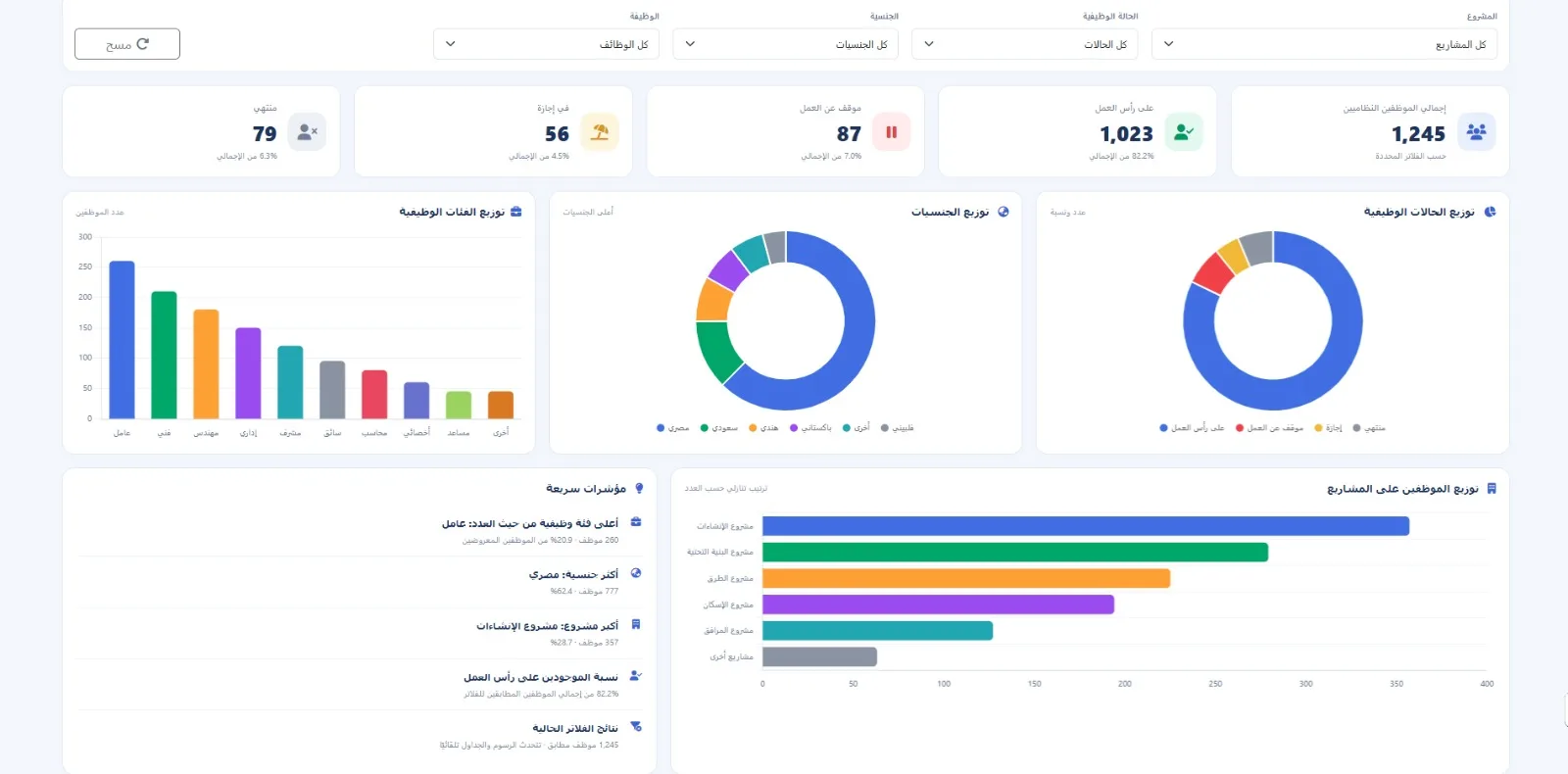
In the modern and highly competitive business environment, Human Resources management is no longer merely an administrative department for maintaining records and issuing payroll; it has become the primary driver for improving operational efficiency, controlling expenses, and guiding growth strategies.
The SAFE ERP Human Resource Management System has been designed and developed as an integrated digital platform that combines all employee-related processes, from the moment of attracting them as a candidate, through all their professional and financial stages, up to the calculation of their end-of-service entitlements.
All of this is delivered within a fully automated work environment, seamlessly integrated in real time with the Finance Department and the banking system, providing senior management with complete control and a comprehensive overview.
First: Standard Specifications and Functions
1. Digital Employee Affairs Management and Smart Profile (360° Employee Profile)
- Unified Digital Employee Identity: A centralized interactive profile containing personal data and dependents, academic qualifications, professional courses and certifications, employment history and promotions, financial history, increments and penalties, and assigned company assets.
- Automation of Employment Movements: Fully automated management and documentation of appointment decisions, joining, transfers between branches, promotions, internal and external assignments, and disciplinary decisions, with a historical Audit Trail for every movement.
- Smart Leave Engine: Instant and automatic calculation of leave balances based on 3 flexible options (granting the full balance at the beginning of the year, linking it to the contract date, or actual cumulative accrual month by month).
- Clearly displaying earned, used, and available balances, with tracking of the number of times leave has been taken to ensure compliance with the organization's policies.
2. Payroll Engine
- Smart Payroll: Accurate processing that integrates basic salary, fixed and variable allowances, additions, deductions, absence and lateness days, adjustments, social insurance and tax deductions, and advances to arrive at the net salary due.
- Dynamic Days Calculation: Accurately calculating the number of days for which salary is due in the month of joining or termination of service, based on the actual joining date.
- Periodic and Monthly Components: Programming recurring additions or deductions for a specified number of months (such as a mission allowance for 3 months), which automatically end upon completion of their period.
- Operational Payroll Segmentation: Issuing separate payrolls for a specified number of employees (by branch, project, department, or nationality), facilitating the distribution of accounting tasks and completing payroll without delay.
- Wage Protection System (WPS): Immediate export of approved bank salary files according to the specified bank formats and the company's agreement details, preventing any legal delays.
- Fully Customizable Formulas: Calculating the daily salary based on a fixed 30 days or the actual number of days in the month, with 3 different rates for each of absence, lateness, and overtime (one hour for one hour, one and a half hours, or two hours), and defining the hourly salary formula and included allowances to match the company's internal work regulations.
- Multiple Payroll Statements: Issuing multiple payroll statements to divide and filter employees according to project, department, or any other customized options.
- Separate Overtime Payroll: Separating overtime entitlements into a dedicated, independent payroll for management and review, or including them within the basic salary payroll as needed.
3. Organizational Structures, Jobs, and Salary Scales
- Multi-Level Hierarchical Structure: Supporting complex organizational structures (Head Office, multiple branches, sectors, departments, sections, and organizational units).
- Standardized Job Description Cards: Precise definition of the job title, duties, and required qualifications for each position to ensure equal opportunities and clarity of responsibilities.
- Salary Scale: Setting a minimum and maximum range (Salary Grading) for each job grade (basic salary, allowances, and symbolic benefits), ensuring financial governance and preventing randomness when transferring an employee between positions or granting increments.
4. Flexible Attendance Management (Check-In and Check-Out)
- Direct integration with fingerprint attendance devices of various types and locations.
- Integration with the mobile application through maps and location tracking for field teams.
- Dedicated screens for manual entry and correction by supervisors and decision-makers.
- Direct and quick entry based on the attendance card when calculating employee salaries.
5. Advances and Custody Management
- Full governance of employee loans and advances, and installment scheduling (fixed installment, percentage of salary, or an agreed schedule), with rescheduling or early cash settlement.
- Instant updating of balances and outstanding amounts through detailed reports that support financial decision-making.
- Tracking advances either through the internal HR advances system or through direct integration with the financial system, according to the company's workflow.
6. Social Insurance Management
- Generating a social insurance sheet compliant with the Social Insurance System, with management of the employee/company share of contributions.
- Automatically generating the accounting entry in compliance with the local content requirements of the financial system.
- Importing data from the Social Insurance Authority's Excel sheet and reflecting the updated values on employees' insurance data automatically.
- Analytical and summary reports on social insurance costs distributed by projects and by employee nationality (citizens and residents).
7. Employee Entitlements Management
- Monthly calculation, as part of the monthly closing procedures, of employee entitlements (leaves, tickets, end-of-service benefits) in the form of opening provision, additions, utilization, and closing balance.
- Generating an accounting entry to recognize the provision for end-of-service benefits, leave expenses, and tickets, distributed across projects, enabling the issuance of an accurate monthly income statement.
- Calculating an employee's entitlement settlement for termination of service, or settlement of temporary entitlements before regular leave, included automatically as settlement items in accordance with company policy.
8. Financial Engineering and Accounting Integration
- Integration with SAFE GL to automatically generate payroll entries, and social insurance and tax accrual entries.
- Calculating and recording leave provisions and end-of-service benefit provisions monthly and automatically on a cumulative basis.
- Accurately allocating and posting salaries and operating expenses (for regular, temporary, or outsourced employees) to cost centers, projects, or departments, providing accurate actual profitability and cost reports for each project or business sector.
Second: Advanced Capabilities
1. Digital Archive, Document Management, and Proactive Alerts
- Dynamic Archiving: Uploading and linking documents in all formats (PDF, Word, Excel, Images) directly to their related transaction, such as attaching the CV to the recruitment request, or the medical report to the sick leave request.
- Smart Early Warning System: Live tracking of the expiration dates of official documents (ID, passport, residency, driving licenses), with customized documents according to the nature of the work (professional practice licenses, access permits for vital facilities).
- Scheduling alerts sufficiently in advance through system notifications, the mobile application, or interactive channels such as Telegram.
2. Strategic Workforce Planning and Talent Acquisition Automation
- Gap and Capacity Analysis: Comparing the approved organizational structure with the positions actually occupied to instantly identify occupancy, shortage, or surplus rates in each department and section.
- Intelligent Turnover Forecasting: Analyzing historical resignation and departure rates by job, department, nationality, and years of service to forecast expected departures and notify the recruitment department to begin proactive recruitment.
- Automated Recruitment Journey: From the department manager's staffing request, through screening CVs in the database, to issuing digital Job Offers that include financial details and benefits.
- Automatic Candidate Conversion: Once the offer is accepted, converting the candidate with a single click into a new employee (regular or temporary), creating their electronic profile, and converting the job offer into an employment contract draft ready for review.
3. Competency-Based Performance Evaluation and Training Management
- Comprehensive Performance Evaluation: Setting targets for the upcoming period (KPIs & OKRs), with customized evaluation forms for each job category (such as evaluating sales employees on figures and engineers on project quality).
- Development and Improvement Map: Identifying strengths and areas for improvement and automatically linking evaluation outcomes to the training plan, then comparing actual performance with previous targets in the following cycle.
- Comprehensive Training Management: Recording internal and external courses, tracking grades and certificates in the employee's profile, integrating with the financial system to settle training center payments, and measuring the return on training investment (ROI).
4. Advanced Workflow and Electronic Approval Engine
- Approving transactions (leaves, advances, assignments) without the need for any paper signatures.
- Automatically routing each request based on request type, organizational structure, department, job title, or the financial authorities granted to the manager.
- Tracking the request status at every stage.
5. Smartphone Application and Self-Services (Mobile App)
- An advanced application (iOS & Android) for regular and temporary employees that reduces the pressure on the HR department by up to 70%.
- Smart Geofenced Attendance (Geo-Fencing): Allowing attendance via mobile only when the employee is within the geographical range of the company or the designated project/client site.
- Self-Service Portal: Submitting requests (leaves, advances, increments, resignation, salary statement inquiries) and tracking their approval cycle moment by moment.
- Circulars and Decisions Center: Instant access to administrative decisions and circulars addressed to the employee.
- Smart Notification System: Instant notifications alerting the employee or manager when official documents or employment contracts are approaching expiration.
6. Executive Dashboards and Management Intelligence
- Workforce Map: Distribution of employees by branches, nationalities, ages, gender, and contract type (regular/temporary).
- Real-Time Attendance Tracking: Identifying employees currently on duty at branches or projects, employees on leave, and expected return dates.
- Control and Risk Dashboard: Monitoring contracts and official documents approaching expiration, employee turnover rates, and the company's overall KPIs.
- Executive Summary: The cost of regular, outsourced, and external employees allocated to each project, monitoring variances and comparing them with the previous year.
7. Triple-Cycle Workforce Management
- Regular Employees Cycle: Managing long-term employment, annual contracts, standardized salary scales, career paths, competency- and target-based evaluation (KPIs), end-of-service provisions and social insurance, benefits and allowances, and continuous professional development.
- Outsiders and Temporary Employees Cycle: A flexible cycle completely separate from regular employees, covering employee data, contract documents and addenda, leave history, work-site security and professional permits, flexible monthly payroll and overtime payroll, integration with the financial system for salary disbursement and project expense allocation, and summary and detailed cost reports by project.
- Outsourced Employees Cycle (Outsourcing): Defining employment companies, entering their contracts and the wage for each job, entering the monthly distribution of outsourced employees and their overtime by job/project, issuing the company invoice and overtime invoice linked to the financial and tax systems, and cost reports by project and employment company, providing a verification level for invoices received from employment companies.
Third: Target Sectors
- All companies and institutions in the public and private sectors.